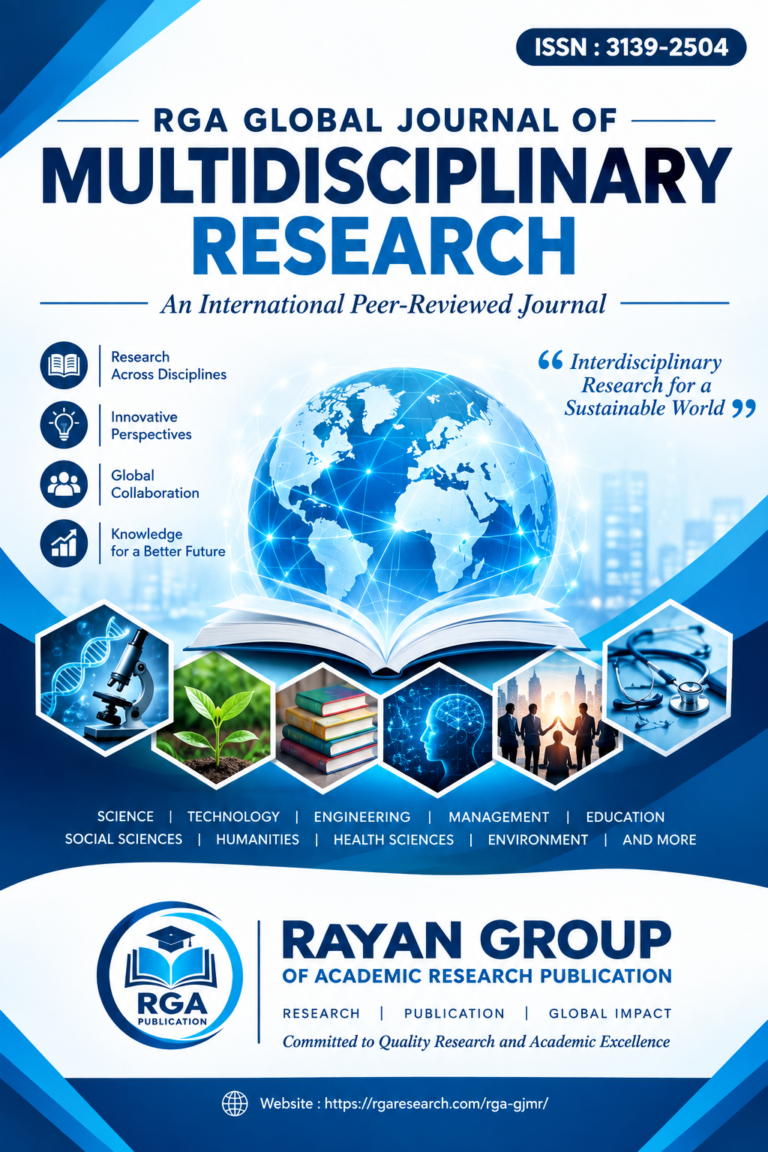
Vol – 1 Issue – 5 (September – October 2026) (Call for Papers)
RGAGJMR Vol. 1 Issue 5 (September – October) – 2026
Call for papers
Greetings!!
Dear scholar,
The RGA Global Journal of Multidisciplinary Research invite researchers, academicians, scholars, and practitioners to submit high-quality manuscripts for publication in our current issue
Submission: Click here or submit.rga@gmail.com
APC: $30 Normal $50 Fast Track
Advantage
- DOI for each articles
- Open-access and globally indexed
- Certificates
- Rapid, rigorous peer review
- Wide academic visibility
- Experienced editorial and review board
Warm regards
Team RGA
Volume 1 [2026]
Vol. 1 Issue 5 (September – October) – 2026
Vol. 1 Issue 4 (July – August) – 2026
Vol. 1 Issue 3 (May – June) – 2026
Vol. 1 Issue 2 (March – April) – 2026


Language: Submissions must be presented exclusively in English.
Page Format: Manuscripts shall be formatted using Microsoft Word with Times New Roman typeface (12-point size), A4 paper dimensions, one-inch margins on all edges, and organized in a single-column layout. Single spacing must be applied throughout the document, encompassing references and tables. The manuscript must not exceed 30 printable pages; any pages beyond this limit may be subject to additional fees.
Manuscript Title: The title should constitute a concise phrase. Author Information: Furnish complete names and institutional affiliations for all contributors, along with electronic mail addresses and telephone contact information for the corresponding author.
Abstract: The abstract must not surpass 300 words in length. Subsequent to the abstract, provide a compilation of keywords (maximum of 7) and a list of abbreviations.
Introduction: The introduction should articulate existing challenges and gaps in the field.
Materials and Methods: The materials and methods section must be delineated with precision and clarity.
Results and Discussion: Authors possess the flexibility to integrate results and discussion into a unified section or to present them as separate components.
Acknowledgment: This section should contain concise information regarding acknowledgments, grant particulars, and identification of funding sources.
References: References shall be positioned at the conclusion of the manuscript in the sequence of their appearance within the text.
Employ bracketed citations in the following format (e.g., Single Author: (Rahul, S. 2018), Multiple Authors: (Rahul et al., 2018)). Adhere to the APA Citation Style guidelines.
Publication Fees: While no submission fees are levied, authors must remit publication fees following manuscript acceptance.
Proofreading and Publication: Proofs will be transmitted to the corresponding author prior to publication. Authors are obligated to conduct thorough examination and submit the corrected proof to the editorial office.
Authors are strongly advised to meticulously follow these guidelines during manuscript preparation and submission to facilitate an efficient review and publication workflow.